Managing Crop Stress for Optimal Yield: How a Complete Program Protects Your Investment
February 28, 2026
In California agriculture, stress is not an exception — it is the baseline condition. Growers in Ventura County, the Central Coast, and the San Joaquin Valley manage crops through heat waves, drought cycles, salt-laden irrigation water, degraded soils, and intensifying disease pressure, often simultaneously. The question is not whether crops will face stress but how well prepared they are to absorb it without losing yield.
The answer to that question is built over time, input by input, program decision by program decision. A plant that enters a heat event with a healthy root system, adequate micronutrient status, active soil biology, and a well-buffered root zone will shed that heat event with minimal yield loss. A plant that enters the same heat event with salt-stressed roots, depleted soil biology, and micronutrient deficiencies will not recover at the same rate — and in high-value crops with tight production windows, a slow recovery means lost revenue.
This is the case for a complete program rather than a collection of individual product decisions. The Zone product line was developed as a system — each product addressing a specific mechanism, and the combination producing effects that no single product can replicate alone.
Understanding Crop Stress: It Is Never Just One Thing
Plant physiologists classify stress into two broad categories: abiotic stress — environmental factors like heat, drought, salinity, and extreme temperatures — and biotic stress — biological challenges including pathogens, pests, and competing organisms. In practice, these categories are deeply interconnected, and the presence of one form of stress almost always amplifies vulnerability to the others.
A soil with high salt concentration creates osmotic stress that damages root cells and reduces water uptake. A root system operating under osmotic stress is less capable of absorbing the micronutrients — particularly zinc and manganese — needed to maintain the enzymatic processes that govern photosynthesis and disease defense. A plant with compromised photosynthetic efficiency produces less carbohydrate to fuel root growth and immune responses. A root system with less active growth is more vulnerable to Phytophthora and other soil-borne pathogens that colonize stressed, low-vigor tissue. And a plant already managing disease pressure has fewer resources to redirect toward fruit development when heat stress arrives during the critical sizing period.
This cascade — stress compounding stress compounding stress — is the reason single-product approaches to crop health management consistently underperform. A complete program addresses all of the contributing mechanisms simultaneously and in the right sequence, building resilience from the ground up rather than responding to crises as they emerge.
The Foundation: Soil Chemistry and Structure
Zone Humic Acid — Rebuilding the Chemical Foundation
Every stress management program begins with soil chemistry. Zone Humic Acid binds and neutralizes excess sodium and accumulating salts, reducing the osmotic pressure that forces plant cells to work harder to extract water from the soil solution. It buffers pH toward the 6.0 to 7.0 range where micronutrient availability is highest and biological activity is most robust. And it builds cation exchange capacity, reducing the leaching losses that strip the root zone of nutrition between irrigation events. In a stress context, humic acid is the platform on which every other stress response tool operates.
Zone Soil Supplement — Rebuilding Physical Structure
Zone Soil Supplement improves aggregate stability, opening the pore structure that allows water to move through the profile after irrigation rather than pooling above a compaction layer. In a drought event, better infiltration means more of each irrigation reaches the root zone. In a heat event, a root system with access to a larger soil volume can draw on moisture from a wider area, buffering the plant against transpiration demand. Zone Soil also provides the organic carbon habitat that soil biology requires to establish and persist through challenging conditions.
The Biology: Nitrogen, Disease Suppression, and Organic Matter Cycling
Zone N Fix — Restoring the Biological Engine
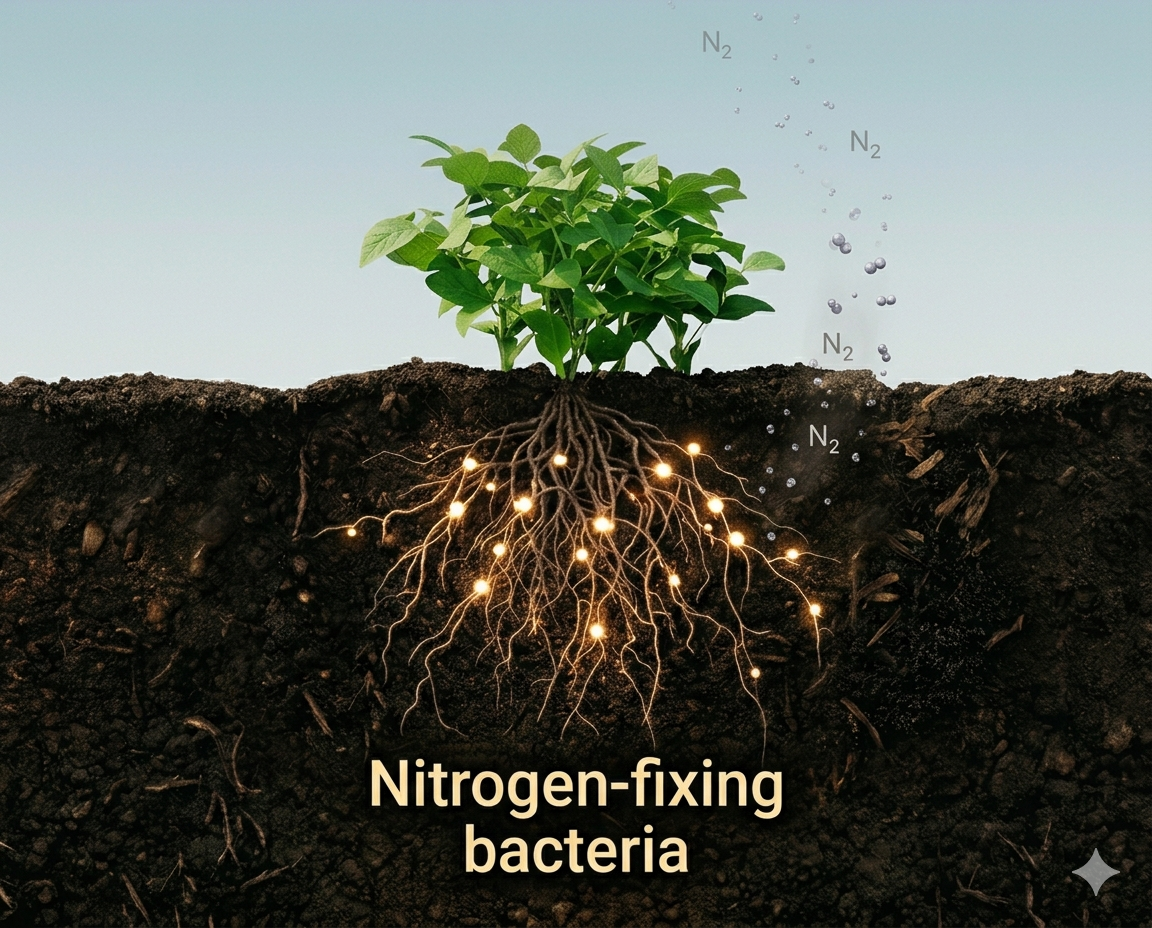
Healthy soil biology is one of the most underappreciated stress management tools in agriculture. Zone N Fix reintroduces Bacillus subtilis, which fixes atmospheric nitrogen and suppresses pathogenic fungi and bacteria through competitive root zone colonization. Rhizobium leguminosarum converts atmospheric nitrogen into organic nitrogen continuously through the growing season. Trichoderma reesei breaks down organic matter, cycling locked-up nutrients into plant-available forms and competing aggressively with Phytophthora — the pathogen most likely to exploit stress-compromised roots in Ventura County's clay-dominated soils. A biologically active soil is a more resilient soil.
Micronutrients: The Stress Response Cofactors
Zone TR-3 and Zone VR-5 — Keeping Enzymatic Systems Functional Under Pressure
Stress events impose elevated demand on the enzymatic systems that govern how plants respond and recover. Antioxidant enzymes that neutralize reactive oxygen species from heat stress require manganese and copper. Auxin synthesis driving root regeneration after drought requires zinc. Photosynthetic recovery requires manganese in the oxygen-evolving complex of Photosystem II.
Zone TR-3 provides chelated zinc (6.0%), chelated manganese (1.0%), chelated copper (0.25%), and boron (0.25%). Zone VR-5 provides chelated copper (1.70%), chelated manganese (4.80%), and boron (0.60%) for programs where disease pressure and photosynthetic efficiency are primary concerns. Both are chelated with citric acid for bioavailability in alkaline conditions. Applied regularly through the season — not as a corrective response but as consistent maintenance — they keep the plant's enzymatic systems at full capacity through whatever stress events occur.
Plant-Level Support: Hormones, Oxygen, and Nitrogen
Zone Aqua 10 — Direct Plant Support Through Stress
Zone Aqua 10 delivers naturally occurring cytokinins, gibberellins, and auxins directly to the plant during and after stress events. Cytokinins delay senescence of leaves under heat-driven transpiration stress. Auxins support continued root tip extension into cooler, moister soil zones as surface soil dries and warms. Gibberellins maintain cell elongation where the plant's own hormone production is suppressed by stress. After the event, these same PGRs accelerate recovery — reducing the lag time between stress resolution and the resumption of normal growth and production. The amino acids in Zone Aqua 10 reduce the metabolic cost of recovery by providing pre-formed building blocks for cellular repair.
Zone Kelp-Gro — Systemic Stress Tolerance and Nitrogen Efficiency
Zone Kelp-Gro complements Zone Aqua 10 with an auxin-emphasized PGR profile. The auxins in Kelp-Gro stimulate stress protein production that protects cellular machinery from heat and drought damage, and support the lateral root development that gives the plant access to a larger soil volume during water stress. Kelp-Gro also improves nitrogen utilization efficiency — in stress conditions where root function is compromised, the plant can do more with the nitrogen it does absorb, maintaining growth at higher rates than it would otherwise achieve. Together, Aqua 10 and Kelp-Gro provide complementary PGR coverage across the full spectrum of above-ground and below-ground stress responses.
Zone N Plus — Fast Nitrogen When the Plant Needs It Most
Stress events suppress both root-based nitrogen uptake and the soil biology that converts organic nitrogen into plant-available forms — precisely when nitrogen demand is rising for recovery. Zone N Plus provides 13.5% water-soluble nitrogen from non-GMO soy protein that is immediately available without requiring active soil biology to convert it. Applied through the fertigation system in the days following a stress event, it supports the protein synthesis and growth resumption that recovery depends on.
Zone Liquia-Cal — Calcium and Nitrogen for Cell Integrity
Under heat and drought stress, rapid water movement through plant tissue disrupts calcium distribution, leading to tip burn in lettuce, blossom end rot in tomatoes, and reduced fruit firmness across a range of crops. Zone Liquia-Cal combines 8% nitrogen and 10% calcium with mannitol acid from kelp extract. The mannitol acid helps neutralize soil salts that disrupt calcium gradients, while the calcium itself maintains the cell wall integrity that allows plant tissue to manage water movement without structural failure.
Zone MS Crystals — The Energy Source for Soil Biology and Plant Metabolism
Zone MS Crystals provide pure cane sugar carbon energy that drives both soil microbial activity and plant metabolic processes. In a stress context, they provide the energy substrate that allows the biological populations introduced by Zone N Fix to establish and maintain high population levels through challenging conditions. They also directly support the enzymatic energy cycle in the plant, contributing to the metabolic activity that stress management demands.
The Multiplying Effect: Why the Sum Is Greater Than the Parts
The true value of a complete program is not additive — it is multiplicative. Consider what happens when these products work together versus independently.
Zone Humic Acid reduces salt osmotic pressure, making it easier for roots to absorb water and micronutrients. Zone Soil improves infiltration so that irrigation water — carrying humic acid, chelated micronutrients, and biological inputs — reaches the root zone efficiently rather than running off or evaporating. Zone N Fix establishes biology that functions more effectively in a soil with better pH and structure. Zone TR-3 and VR-5 maintain the enzymatic systems that the biology depends on to function. Zone Aqua 10 and Kelp-Gro support the PGR environment that keeps roots growing into the improved soil zone. Zone N Plus and Liquia-Cal provide the nitrogen and calcium that the recovering plant needs to resume production.
Each product unlocks more of the potential of every other product in the program. A plant growing in humic acid-treated, biologically active soil with adequate micronutrient status and PGR support does not simply perform as the sum of each individual benefit — it performs at a level that reflects the synergy between all of them simultaneously.
This is why growers who run a complete Zone program consistently report results that outperform what they expected from any single product. It is not one product working better. It is an entire biological and chemical system operating at a higher level of integration.
Building Your Program: A Practical Starting Point
For growers new to a complete program approach, the entry sequence matters. Beginning with soil chemistry and structure before introducing biology, and building plant-level support on top of a stable soil foundation, produces better establishment and more durable results than starting with biology in soils that are still severely salt-stressed or compacted.
A practical starting sequence for Ventura County conditions: Zone Humic Acid and Zone Soil Supplement established first to address soil chemistry and structure. Zone N Fix introduced as soil conditions improve, supported by Zone MS Crystals for biological energy. Zone TR-3 and VR-5 running continuously through the foliar or drip program. Zone Aqua 10 and Kelp-Gro applied at key crop stages and in response to stress events. Zone N Plus and Liquia-Cal available for targeted correction during peak demand or post-stress recovery.
The Bottom Line
Crop stress is not a problem to be solved by a single product. It is a system-level challenge that requires a system-level response — one that addresses soil chemistry, physical structure, biology, micronutrient status, and plant-level hormonal support simultaneously, and in the right sequence. The Zone product line was built to provide exactly this.
The growers who experience the greatest resilience to heat, drought, salinity, and disease are not the ones who find the best individual products. They are the ones who build programs where every component supports every other component — where the soil, the biology, the plant nutrition, and the plant itself are all operating at the highest level they can sustain.
For help designing a complete stress management program for your specific crops, soils, and growing conditions in Ventura County or across California, contact the Farm Rite USA team. We are here to help you build a program that protects your investment through whatever the season brings.
Sharing is caring
If you found value in this blog post, please take a moment to share it on social media. Your support helps us continue to create valuable content.