.jpeg)
Why Kelp Works: Biostimulants and Avocado Fruit Set
March 20, 2026
Walk into any farm supply store in California and you'll find kelp extract on the shelf. Most growers reach for it because it works — plants respond to it, yields tend to improve, and it plays well with everything else in a fertility program. But ask why kelp works at a biological level and the answer gets interesting fast.
The reason kelp has such a broad positive effect on crop performance isn't just nutrition. It's hormones — specifically, a class of naturally occurring compounds called plant growth regulators (PGRs) that kelp contains in bioactive forms. These are the same hormonal signals that govern how a plant flowers, whether a fruit stays on the tree or drops off, and how large that fruit ultimately grows.
For avocado growers in California, understanding these compounds — and the research behind them — offers a new lens for thinking about what kelp actually does in an orchard, and when to apply it for maximum effect.
What Are Plant Growth Regulators?
Plant growth regulators are hormone-like compounds that act as the internal signaling system inside a plant. Unlike nutrients, which provide the building blocks for growth, PGRs direct where growth happens, how fast it happens, and when it stops. They govern everything from root initiation and shoot elongation to flower formation, fruit set, fruit sizing, and ultimately fruit drop and ripening.
The three PGR classes found naturally in kelp — and most directly relevant to avocado production — are indole-3-acetic acid (IAA, the primary natural auxin), gibberellins (GA), and cytokinins. Understanding what each one does at each stage of fruit development is the key to understanding why kelp applications timed correctly can have a meaningful impact on yield.
The Hormone Sequence Behind Fruit Development
Dr. Carol Lovatt, Professor Emerita of Plant Physiology at the University of California, Riverside, has spent decades researching plant growth regulators in tree crops, with particular focus on avocado. Her work provides one of the clearest explanations of how hormones sequence through the process of fruit development — and what happens when that sequence breaks down.
The framework is straightforward: different PGRs dominate different stages of fruit development, and the plant's ability to produce them at the right time in the right amounts is what determines whether a fruit sets, stays on the tree, and reaches a commercially valuable size.
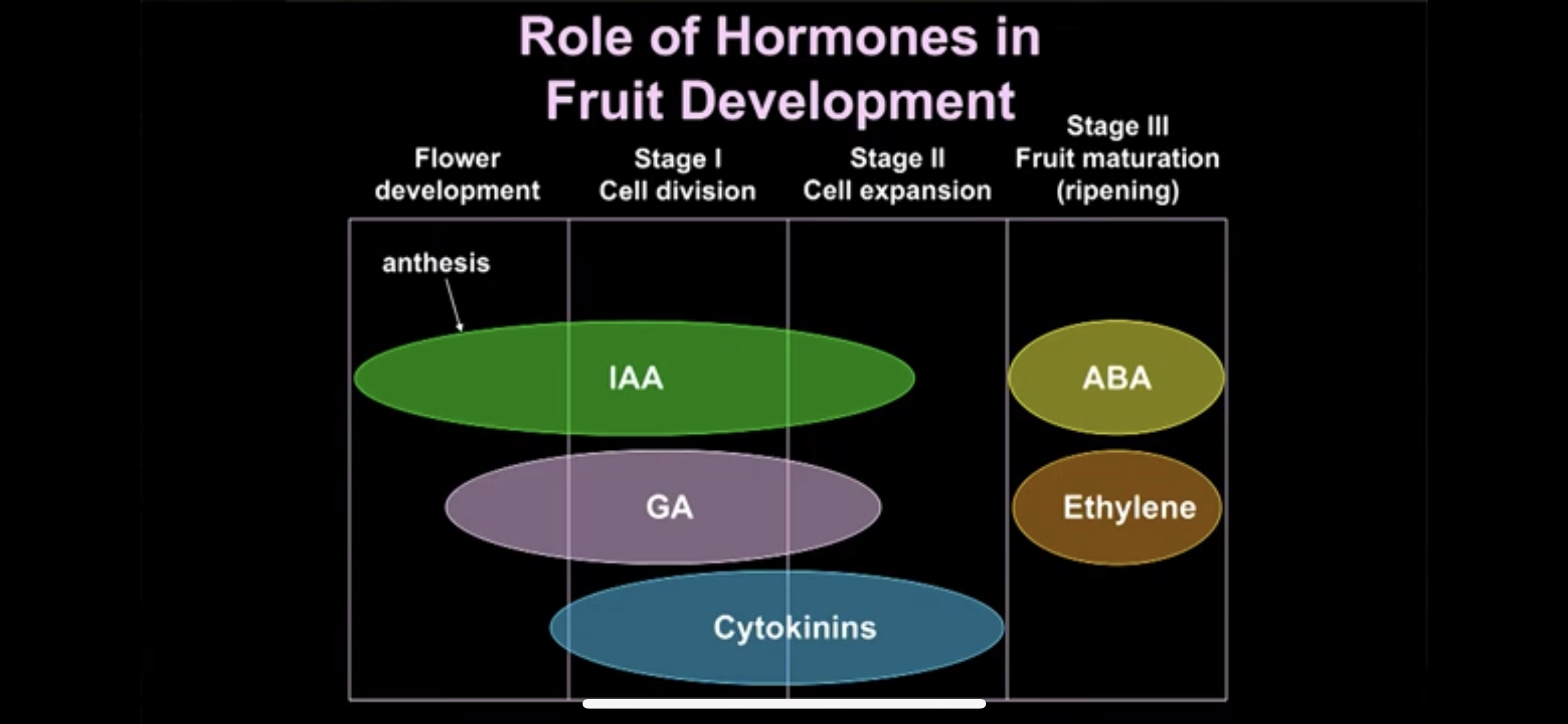
Starting at anthesis — the moment of flower opening — IAA is the dominant hormone. It bridges flower development all the way through Stage I and Stage II of fruit growth. GA becomes critical at Stage I (cell division) and continues through Stage II (cell expansion). Cytokinins concentrate in Stages I and II, driving the cell division that determines final fruit size. ABA and ethylene don't enter the picture until Stage III — fruit maturation and ripening — where they trigger the senescence and softening process.
What this means practically is that the early season — from bloom through the first months of fruit development — is the window during which PGR availability most directly determines yield outcome. A plant that cannot maintain adequate IAA, GA, and cytokinin levels during this period will drop fruit. A plant that can will set and size a commercial crop.
IAA — The Foundation Hormone
Indole-3-acetic acid (IAA) is the most abundant and biologically active natural auxin in plants. In the context of avocado fruit set, its most important role is in preventing abscission — the process by which the plant actively severs the connection between a fruit and the tree, causing it to drop.
Avocado is notoriously prone to dropping fruit. The June drop phenomenon — in which the tree sheds large numbers of young fruit — is driven in part by a decline in IAA production within the developing fruitlets. When IAA levels fall below a critical threshold, the plant interprets the fruit as a low priority and initiates the abscission process. Maintaining auxin levels in developing fruit during this vulnerable period is one of the mechanisms by which well-timed kelp applications can reduce drop and improve set.
IAA also plays a critical role at the point of anthesis — flower opening. Pollen germination and tube growth are auxin-dependent processes, and adequate IAA availability at bloom supports successful fertilization, which is the necessary first step before any of the downstream fruit development hormones can do their job.
Kelp naturally contains IAA in bioactive form. Applied at or before bloom, it contributes to the auxin pool available to the plant during the most IAA-dependent phase of the entire growth cycle.
Gibberellins — What Dr. Lovatt's Research Tells Us
Of the three PGR classes found in kelp, gibberellins have received the most focused research attention in avocado — much of it from Dr. Lovatt's laboratory at UC Riverside.
Her research over several decades established that gibberellic acid (GA₃) applied at the cauliflower stage of inflorescence development — just before the flowers open — can meaningfully increase avocado fruit size and yield. This work ultimately led to GA₃ receiving approval for use on avocado in California in 2018, the first registered plant growth regulator for this crop.
The research found that GA₃ applied during the periods of intense flower and fruit abscission produced the most significant yield response. In trials on Hass avocado, applications during the abscission periods resulted in a two-year cumulative increase of more than 100 commercially valuable fruit per tree above untreated controls. Critically, the response was crop-load dependent — well-managed trees in an on-crop year responded most strongly, while off-crop year trees showed minimal response.
The mechanism is that gibberellins support cell division and expansion within the developing fruit, help maintain the hormonal environment that keeps fruit attached to the tree, and influence the size of the cell population that ultimately determines how large the fruit can grow.
Kelp contains naturally occurring gibberellins — not at the concentrated levels used in a targeted GA₃ program, but in a form that provides a background hormonal signal throughout the season. For growers who want to support GA activity in their orchard organically — without a separate registered PGR program — kelp represents the most accessible natural source of gibberellins available in a conventional fertility program.
Cytokinins — The Cell Division Driver
Cytokinins are the least discussed of the three PGR classes but arguably the most important for final fruit size. Their primary role in fruit development is driving cell division during Stage I — the period immediately after fruit set when the number of cells in the developing fruit is established. Because cell expansion in Stage II is limited by the number of cells created in Stage I, a fruit that doesn't have strong cytokinin activity early in development is biologically capped in how large it can ultimately grow, regardless of how much nutrition or water it receives later in the season.
Cytokinins in kelp are present in active forms, primarily zeatin and zeatin riboside — the same cytokinin forms that plants produce endogenously. This means kelp-derived cytokinins are biologically available to the plant rather than requiring conversion before they can be utilized.
Beyond fruit sizing, cytokinins also delay senescence in the leaves that are actively feeding the fruit load. An avocado carrying a heavy crop puts significant demand on its leaf canopy to supply the carbohydrates and nitrogen needed to sustain fruit growth. Cytokinin activity helps maintain leaf function during this demanding period, keeping the photosynthetic engine running when the fruit needs it most.
Why Kelp Works Differently Than a Single PGR Application
The distinction between a targeted GA₃ application and a kelp program is worth understanding clearly, because they serve different purposes and are most powerful when used together — or, for growers who prefer a fully organic approach, when kelp is used as the primary PGR support tool.
A registered GA₃ application is a single-hormone intervention timed to a specific phenological stage. It delivers a concentrated dose of gibberellin at the moment the plant is most responsive to it. The research shows it works well for this purpose on well-managed trees in on-crop years.
Kelp provides something different: a lower-dose, multi-hormone signal delivered continuously across the season. Rather than spiking one hormone at one moment, regular kelp applications maintain background levels of IAA, GA, and cytokinins throughout flowering, fruit set, and the early stages of fruit development. This sustained support matches more closely how the plant's own hormonal system is designed to work — not in spikes but in an ongoing, overlapping sequence.
For California avocado growers focused on organic production, OMRI-certified kelp products provide this PGR support without synthetic inputs, making them compatible with organic certification while still delivering the hormone activity that fruit set and sizing depend on.
Two Kelp Products, Two Complementary Roles
Farm Rite USA offers two OMRI-certified kelp products that provide complementary PGR profiles for avocado programs. Understanding the distinction between them allows growers to target the specific hormonal needs of each crop stage more precisely.
Zone Aqua 10 is derived from select proprietary processed brown kelp and is formulated to emphasize cytokinins and their role in cell division, root development, and canopy maintenance. Its cytokinin-forward profile makes it particularly valuable at transplanting and during fruit set — the Stage I window when cell division in the developing fruitlet is most active. Zone Aqua 10 also contains key enzymes and amino acids that reduce the metabolic cost of growth and recovery, and provides an optimum level of free exchange oxygen that supports cellular respiration in the root zone. For avocado growers it is most impactful applied pre-bloom through fruit set, supporting root health and the cell division that determines final fruit size potential.
Zone Kelp-Gro is derived from Ascophyllum nodosum and emphasizes auxins and gibberellins, making it particularly effective for stem strength, leaf growth, nitrogen utilization efficiency, and the stress tolerance responses that protect the plant during challenging conditions. Its auxin profile supports the abscission prevention mechanism that keeps fruit on the tree during the June drop window, and its gibberellin content provides the background GA signal that complements targeted PGR programs. Zone Kelp-Gro is effective applied from pre-bloom through the fruit sizing period, and its nitrogen utilization benefit makes it a practical addition to any stage of the seasonal program.
Used together, Zone Aqua 10 and Zone Kelp-Gro provide the full spectrum of kelp-derived PGR activity — Aqua 10 leading with cytokinin support for cell division and root health, Kelp-Gro leading with auxin and gibberellin support for fruit retention, stem integrity, and nitrogen efficiency. The two products address different stages of the hormone sequence that Dr. Lovatt's research identifies as critical to avocado fruit set and sizing, making their combined use a more complete approach than either product alone.
Practical Application for California Avocado Growers
Based on the hormone sequencing research and the known activity of kelp-derived PGRs, the most productive windows for kelp applications in a Hass avocado program are:
Pre-bloom: Apply Zone Aqua 10 and Zone Kelp-Gro 2 to 3 weeks before anticipated bloom to support IAA availability at anthesis and prime cytokinin activity for the cell division phase that follows fertilization.
At bloom / cauliflower stage: This is the moment Dr. Lovatt's research identifies as most critical for GA activity. Zone Kelp-Gro delivers natural gibberellins and auxins when the inflorescence is most responsive to them. Zone Aqua 10 supports cytokinin activity and root health during this high-demand period.
Post-set through June: The period from fruit set through the June drop window is the most vulnerable phase for fruit retention. Zone Kelp-Gro maintains auxin levels that signal the plant to retain developing fruit. Zone Aqua 10 supports the cytokinin-driven cell division that determines final fruit size potential.
Both products are OMRI-certified for use in organic avocado orchards and are formulated for easy integration into drip, foliar, or injection programs.
The Bottom Line
Kelp isn't magic — it's biochemistry. The plant growth regulators it contains are the same hormonal compounds that govern fruit set, fruit retention, and fruit sizing in avocado, and their availability at the right stages of development has a direct influence on yield outcome. Dr. Lovatt's decades of research on gibberellic acid in avocado provides the scientific framework for understanding exactly why these compounds matter — and when they matter most.
Zone Aqua 10 and Zone Kelp-Gro each bring a distinct PGR profile to the program — and together they cover the full hormone sequence from anthesis through fruit sizing more completely than any single product can. For California growers looking to support fruit set naturally, a dual kelp program applied at the right phenological windows is one of the most well-grounded organic approaches available. Want to build a kelp program tailored to your orchard's crop cycle and irrigation setup? Contact the Farm Rite USA team — we're here to help.
Read Next: Getting Transplants Off to the Right Start: Zone Aqua-10 and Root Establishment
Sharing is caring
If you found value in this blog post, please take a moment to share it on social media. Your support helps us continue to create valuable content.