Rebuilding Degraded Soils in Ventura County: A Grower's Guide to Salinity, Compaction, and pH
April 4, 2026
Ventura County is one of California's most productive agricultural regions — and one of its most demanding for soil management. The same factors that make it exceptional for growing avocados, strawberries, lemons, and celery also create persistent soil health challenges that quietly reduce yields, increase input costs, and erode the long-term productivity of the land.
Salinity. Compaction. High pH. These three problems often occur together, reinforce each other, and become progressively harder to manage without the right approach. Understanding what causes each one — and how organic inputs can address them — is foundational to maintaining high-performing soils in Ventura County's unique growing environment.
The Ventura County Soil Context
Ventura County's soils are shaped by its coastal geography — marine terraces, alluvial deposits from the Santa Clara and Ventura Rivers, and volcanic influences across the inland valleys. The county's 14 recognized soil associations vary significantly in texture, drainage, and chemistry depending on location. In the Oxnard Plain and Santa Clara Valley, the dominant soils are productive clay loams and loams well-suited to intensive vegetable and orchard production. In the Las Posas Valley and Camarillo areas — home to a large portion of the county's avocado acreage — heavier clay loam soils with restricted internal drainage create specific challenges around water management and root health.
The county's Mediterranean climate, with dry summers and relatively limited annual rainfall between 12 and 20 inches, means that whatever salts enter the soil through irrigation water have limited opportunity to leach naturally. Over seasons of intensive production, these salts accumulate. Combined with the effects of heavy equipment, repeated tillage, and high fertilizer loads, the result is a suite of interrelated soil problems that are common across Ventura County farms of all sizes.
Problem 1 — Salinity: The Silent Yield Reducer
Salt accumulation is the most widespread soil challenge in Ventura County agriculture. It builds gradually and its effects are often attributed to other causes — drought stress, nutrient deficiency, disease pressure — before the root cause is identified.
The mechanism is straightforward. Every irrigation event deposits dissolved minerals into the soil. Plants take up water but leave most salts behind. Evaporation concentrates what remains. In the absence of significant leaching rainfall, salts accumulate in the root zone over time. Well waters in the Ventura area present a specific additional challenge: many contain elevated boron levels that are toxic to sensitive crops like avocado and citrus even at relatively low concentrations.
The consequences for plant health are significant. Elevated soil electrical conductivity (EC) creates osmotic stress — the soil solution becomes sufficiently concentrated that plants struggle to absorb water even when moisture is present. Root tips are damaged, nutrient uptake is impaired, and the plant shifts energy away from fruit development toward managing physiological stress. In avocados, this manifests as leaf tip burn, reduced new growth, poor fruit set, and in severe cases, decline of individual scaffold branches.
In strawberries on the Oxnard Plain — where continuous production on the same ground and the use of recycled irrigation water can accelerate salt loading — elevated EC is one of the primary reasons for inconsistent plant establishment and uneven yield across a block.
Problem 2 — Compaction: The Root Barrier
Soil compaction in Ventura County is largely a consequence of intensive production practices — repeated passes with tractors and harvest equipment, tillage at consistent depths that creates a hardpan layer, and in some fields, the natural tendency of heavier clay-loam soils to consolidate under traffic and irrigation pressure.
The effects of compaction go beyond restricted root penetration, though that alone is costly. Compacted soils have reduced pore space, which limits both air and water movement. Anaerobic conditions develop more easily, which promotes denitrification and the loss of applied nitrogen, and creates a favorable environment for root pathogens including Phytophthora — a significant concern in Ventura County avocado groves where drainage is already restricted by heavier subsoil horizons.
Compaction also concentrates salts. In a well-structured soil with adequate drainage, excess salts can be moved through the profile with irrigation. In a compacted soil, water pools above the restrictive layer, concentrates, and re-deposits salts in the root zone rather than moving them through and out.
The interaction between compaction and salinity is one of the primary reasons why salt problems in Ventura County soils are often more severe than the irrigation water EC alone would predict. The soil's physical condition determines whether management inputs can reach the root zone and whether excess salts can be displaced.
Problem 3 — High pH: The Nutrient Lock
Ventura County soils tend toward alkaline pH, particularly in the heavier clay loam soils of the inland valleys where calcareous parent material is common. Irrigation water in parts of the county with high bicarbonate content drives pH up further over time, particularly in drip-irrigated orchards where water is applied repeatedly to the same zone.
High pH — generally anything above 7.5 — progressively locks out micronutrients. Iron, zinc, manganese, and boron shift into insoluble forms that plant roots cannot access regardless of how much is present in the soil or applied as fertilizer. Avocados are particularly sensitive to iron and zinc deficiency in high-pH conditions, showing interveinal chlorosis in new growth that is often mistaken for a nutrient application problem rather than a soil chemistry problem.
High pH also suppresses soil biology. Most beneficial microorganisms — the bacteria and fungi responsible for nutrient cycling, organic matter decomposition, and nitrogen fixation — function optimally in a pH range of 6.0 to 7.0. Above 7.5, microbial populations decline, the biological activity that drives natural nutrient release slows, and the soil increasingly depends on synthetic inputs to compensate for what biology can no longer provide.
How These Problems Compound Each Other
Salinity, compaction, and high pH rarely occur in isolation on working Ventura County farms. Salt-affected soils are frequently also high pH — excess sodium raises pH as it displaces calcium on the cation exchange sites of clay particles. Compacted soils restrict drainage and concentrate salts. High pH depresses the microbial activity needed to break down organic matter and build the soil structure that resists both compaction and salt accumulation.
The practical implication is that addressing any one of these problems in isolation produces limited results. Applying additional micronutrients to a high-pH soil without addressing the pH provides limited benefit because the nutrients remain locked in insoluble forms. Reducing salinity with leaching irrigation in a compacted soil produces limited improvement because water movement through the profile is restricted. Building a successful long-term soil remediation program requires addressing soil chemistry, physical structure, and biology together.
Natural Remediation: Four Tools That Work Together
The Zone product line provides four complementary inputs that address the full spectrum of degraded soil conditions common in Ventura County. Each targets a different mechanism, and their combined effect is greater than any single product applied alone.
Zone Humic Acid — The Foundation of Chemical Remediation
Humic acid derived from Leonardite is one of the most well-established tools for addressing salt-affected, high-pH soils organically. Its molecular structure allows it to bind and neutralize excess sodium and other accumulating salts, reducing their osmotic effect on plant roots. It buffers soil pH, creating a more favorable chemical environment for both nutrient availability and microbial activity. And it significantly increases cation exchange capacity (CEC) — the soil's ability to hold nutrients in plant-available form — which is typically very low in degraded, salt-affected soils that have lost organic matter.
In Ventura County avocado and citrus orchards dealing with high-bicarbonate irrigation water and accumulating soil sodium, Zone Humic Acid is the logical first input in a remediation program. Applied through drip systems, it reaches the active root zone where the chemistry problems are most acute. OMRI-certified for organic operations.
Zone Soil Supplement — Physical and Biological Structure
Zone Soil Supplement addresses the physical dimension of soil degradation — improving aggregate stability, enhancing water infiltration, and creating the pore structure that allows both air and water to move freely through the root zone. In compacted Ventura County soils, improved infiltration has a direct benefit for salt management: better water movement through the profile means excess salts can be moved below the root zone rather than concentrating within it.
Zone Soil also supports the biological recovery of degraded soils by providing the organic carbon framework that soil microorganisms need to establish and thrive. In heavily worked strawberry ground on the Oxnard Plain that has been through multiple seasons of fumigation and intensive fertility programs, rebuilding the organic fraction of the soil is a precondition for restoring biological function.
Zone N Fix — Restoring Soil Biology
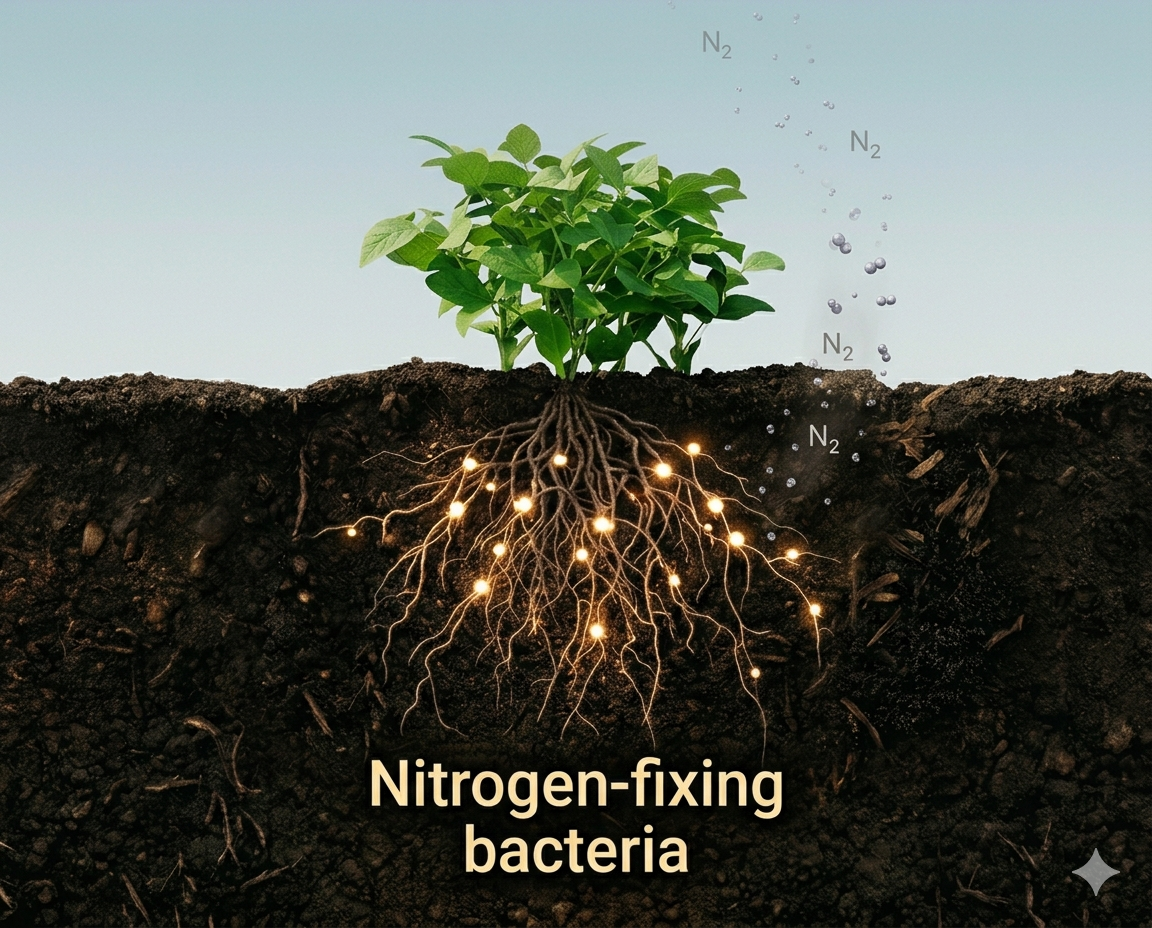
Salt-affected, compacted, high-pH soils are biologically depleted soils. The bacteria and fungi responsible for nitrogen cycling, organic matter decomposition, and natural disease suppression have been reduced by adverse soil chemistry, physical restriction, and years of synthetic inputs. Zone N Fix re-establishes the biological populations that drive natural soil function — specifically Bacillus subtilis, Rhizobium leguminosarum, and Trichoderma reesei — organisms that fix atmospheric nitrogen, cycle organic nitrogen into plant-available forms, and suppress the root pathogens that exploit stressed, poorly draining soils.
In Ventura County avocado orchards where Phytophthora root rot risk is elevated by clay subsoils and restricted drainage, the Trichoderma component of Zone N Fix provides an important secondary benefit: active biological competition against the pathogen in the root zone, reducing disease pressure while soil physical conditions are being addressed through the rest of the program.
Zone Aqua 10 — Supporting Plant Health During Recovery
Rebuilding degraded soils takes time. While humic acid, soil amendments, and biology programs are doing their work at the soil level, Zone Aqua 10 supports the plant directly — providing naturally occurring cytokinins, gibberellins, and auxins that help the plant manage stress, maintain root development, and continue producing through the recovery period.
In salt-stressed plants, root function is compromised at the cellular level. The plant growth regulators in Zone Aqua 10 support continued cell division and root tip extension, helping the plant push roots into improved soil zones as the remediation program takes effect. Applied as a foliar or through the drip system, it bridges the gap between starting a soil health program and seeing the full agronomic benefit in plant performance.
A Practical Remediation Sequence for Ventura County Growers
For growers managing degraded soils in Ventura County, a phased approach produces the most consistent results:
Phase 1 — Address chemistry first. Begin with Zone Humic Acid applied through drip or injection to reduce salt osmotic pressure, buffer pH, and build CEC. This creates the chemical conditions in which biological and structural amendments can function. Run concurrent foliar applications of Zone Aqua 10 to support plant health while the soil chemistry improves.
Phase 2 — Build structure. Incorporate Zone Soil Supplement to improve aggregate stability and drainage. In severely compacted blocks, this should follow or accompany any mechanical remediation such as deep ripping, which creates the fracture channels through which the amendment can penetrate.
Phase 3 — Restore biology. Once soil chemistry and structure are moving in the right direction, introduce Zone N Fix to re-establish the microbial populations that drive long-term soil function. Biological programs establish most effectively in soils that are no longer severely salt-stressed or pH-restricted — timing the introduction of biology after the chemistry is partially corrected significantly improves establishment success.
Ongoing — Maintain with a complete program. Once soil health is restored, all four Zone products can be run as part of a standard seasonal program at maintenance rates to prevent re-degradation. The goal is a soil system that is self-sustaining through active biology, adequate organic matter, and well-buffered chemistry — reducing the need for corrective interventions over time.
The Bottom Line
Ventura County's unique combination of coastal soils, semi-arid climate, intensive production pressure, and challenging irrigation water quality makes soil degradation a practical reality for most commercial growers in the region. The good news is that these problems are addressable — not through a single product applied once, but through a systematic program that treats soil chemistry, physical structure, and biology as an integrated system.
Farm Rite USA is based in Ventura County. We understand the soil conditions, the crops, and the pressures local growers face because we work in the same environment. If you're managing salinity, compaction, or pH problems on your operation, we'd like to help you build a program specific to your soils and crops. Contact the Farm Rite USA team to get started.
Read Next: How to Fix Nitrogen Deficiency in Crops Naturally
Sharing is caring
If you found value in this blog post, please take a moment to share it on social media. Your support helps us continue to create valuable content.



.jpeg)